


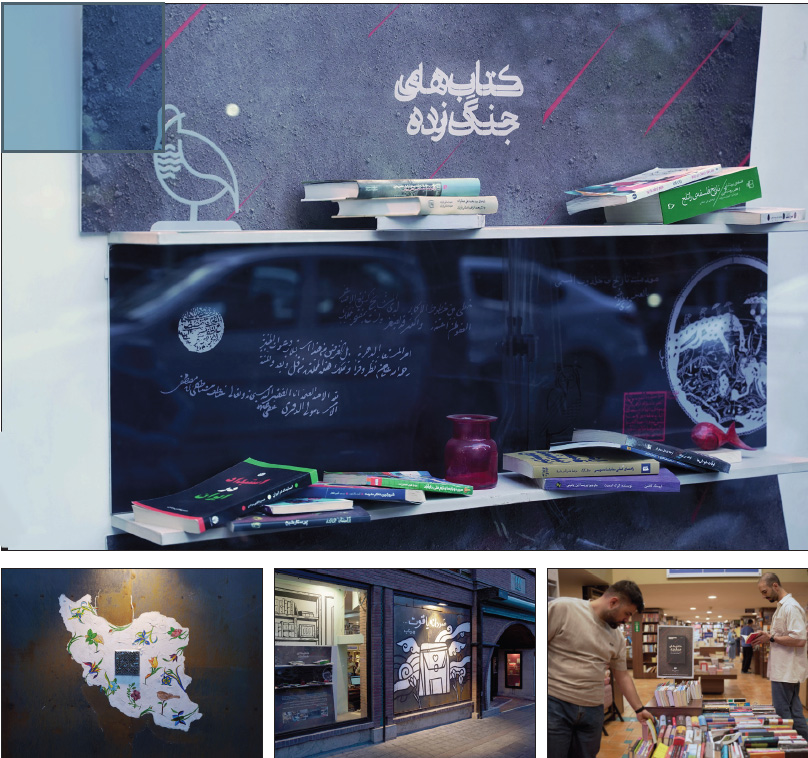
Run your hand across the bent covers and torn corners of these books, and it quickly becomes clear that they are more than paper and ink. They are survivors of a violent episode, carrying traces of a silent resilience that speaks directly to their readers. The smell of gunpowder may have long faded from the damaged walls of the city, yet opening one of these volumes reveals how those turbulent days continue to live on within the shelter of words.
Many of these books were present at Bahman BookCity when the cultural center was damaged during the war. Their covers were scarred, their pages stained by dust and debris, and some suffered physical damage from the impact of the attacks. Yet they survived. Today, bearing the visible marks of those events, they stand as quiet reminders that words can endure even when buildings do not.
Now these books have returned to public view—not as pristine copies, but as witnesses to survival. “War-Scarred Books” is the title of an exhibition at Central BookCity featuring volumes recovered from the damaged Bahman BookCity branch. The exhibition transforms these wounded books into storytellers, preserving the memory of a difficult chapter while celebrating endurance and recovery.

Speaking about the origins of the exhibition, Saeed Damirchi, Director of Bahman BookCity, explained that after the war the team faced a difficult choice: rebuild the branch or close it permanently.
“The damage to the building was so extensive that reconstruction was not a realistic option,” he said. “As a result, we were forced to close the branch. Some of the books were transferred to Central BookCity, and together we developed the idea of exhibiting and selling the damaged volumes. The proceeds would help us meet our obligations to suppliers while also preserving the story of what happened.”
According to Damirchi, the public response during the exhibition’s opening days was encouraging. Readers have shown strong interest in acquiring the books, not only as reading material but also as tangible reminders of a significant moment in the cultural life of the city.
Reflecting on the future of Bahman BookCity, he noted that rebuilding the original location remains uncertain due to the high costs involved. Nevertheless, he expressed hope that the project could one day be revived in a new space if adequate support becomes available.

Pedram Alvandi, Director of Central BookCity, described the books as items that could no longer be returned through ordinary publishing and distribution channels because of their condition. Instead, the books were carefully cleaned and offered to readers at a discounted price, accompanied by explanations about their history.
“Purchasing one of these books is both a gesture of support for Bahman BookCity and a way of preserving a meaningful memory,” Alvandi said. “We wanted these books to find a place in people’s personal libraries rather than disappear into storage. They carry a story that deserves to be remembered.”
He also emphasized the cultural significance of Bahman BookCity, which had become an important gathering place for readers, young people, and families in southern Tehran. Its loss, he noted, represented not only damage to a building but also a setback for the cultural life of the surrounding neighborhoods.
The exhibition of war-scarred books at Central BookCity highlights both the vulnerability and resilience of cultural institutions. Through these damaged volumes, visitors encounter not only the traces of destruction but also the enduring power of books to preserve memory, connect communities, and outlast adversity.