


The outcome matters deeply to us as well. Naturally, every reader wants to know how their chosen book fares in the final rankings. We want to see which titles rise to the top and what literature our peers across the country are voting for.
Yet at a certain point, a subtle distortion can occur: we stop discussing the intrinsic quality of books and become obsessed with ensuring “our title” defeats “their title.”
In competitive sports like football, rallying behind ‘our team’ against ‘their team’ is instinctive and joyful. In the world of literature, however, adopting partisan rivalry feels distinctly bizarre. A novel is not an athletic squad competing to score goals. Nonetheless, when a popular title surges ahead in online voting on the Sand Fox platform (sandfox.ir), tribal fan loyalty easily infiltrates the literary conversation. Voting for a quieter, alternative book suddenly feels intimidating—as though you are defying the collective herd.
A book that garners fewer votes is by no means an inferior work. Perhaps it received less commercial distribution; perhaps its thematic universe was tailored to a niche audience; or perhaps it resonated profoundly with ten dedicated readers while remaining an ordinary diversion for a hundred others. Hierarchical ranking tables invariably flatten and erase these delicate qualitative distinctions.
Literary trends and social buzz are not inherently harmful. Often, a wave of social excitement encourages adolescents to explore titles they might otherwise never pick up from library shelves. Even within our own youth coordinating circle at BookCity, widespread buzz frequently prompts us to crack open an unfamiliar volume. The peril arises when conformity takes over: when young readers feel compelled to praise whatever the crowd celebrates simply to avoid feeling left out.
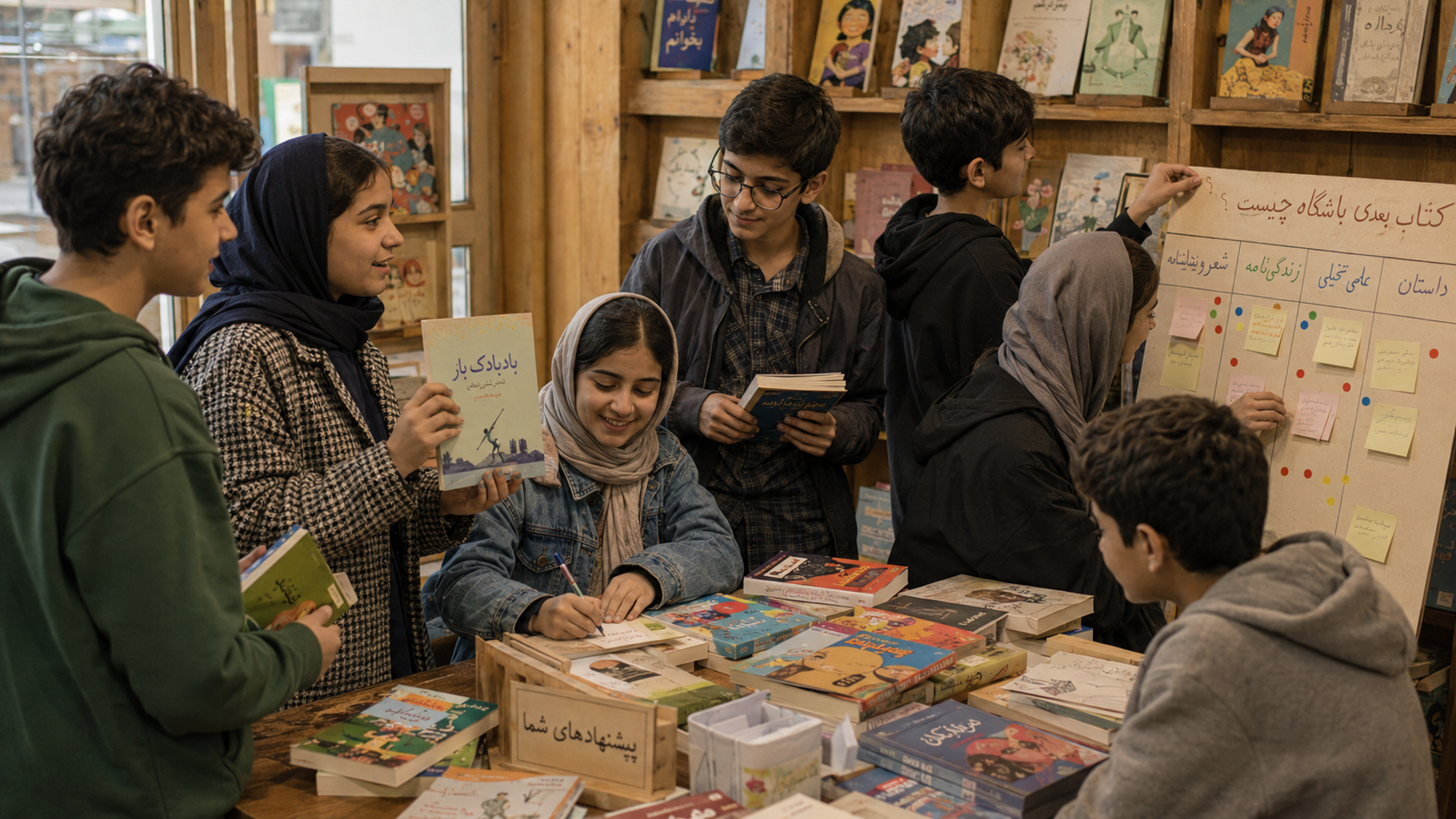
As organizers of the Sand Fox Award—an independent, youth-adjudicated national literary prize founded to empower Iranian readers aged 11 to 18 without adult paternalism—we produce promotional video reels, run outreach campaigns, and carry posters directly to independent booksellers along Tehran’s Enghelab Street. Consequently, we cannot disingenuously pretend that promotion has no influence on reader choices. The real dilemma is: how do we introduce the prize dynamically without inadvertently pre-selecting frontrunners?
We do not claim to possess an easy formula. We want the vibrant excitement of community voting to endure, but we firmly believe that when the voting closes, the conversation must not shrink to merely celebrating the winner’s name. Celebrating fresh discoveries, honoring bold translations, and having serious dialogues about why diverse books matter is the true purpose of the Sand Fox initiative. Perhaps that self-critical inquiry is something we must pose to ourselves with every new cycle.