


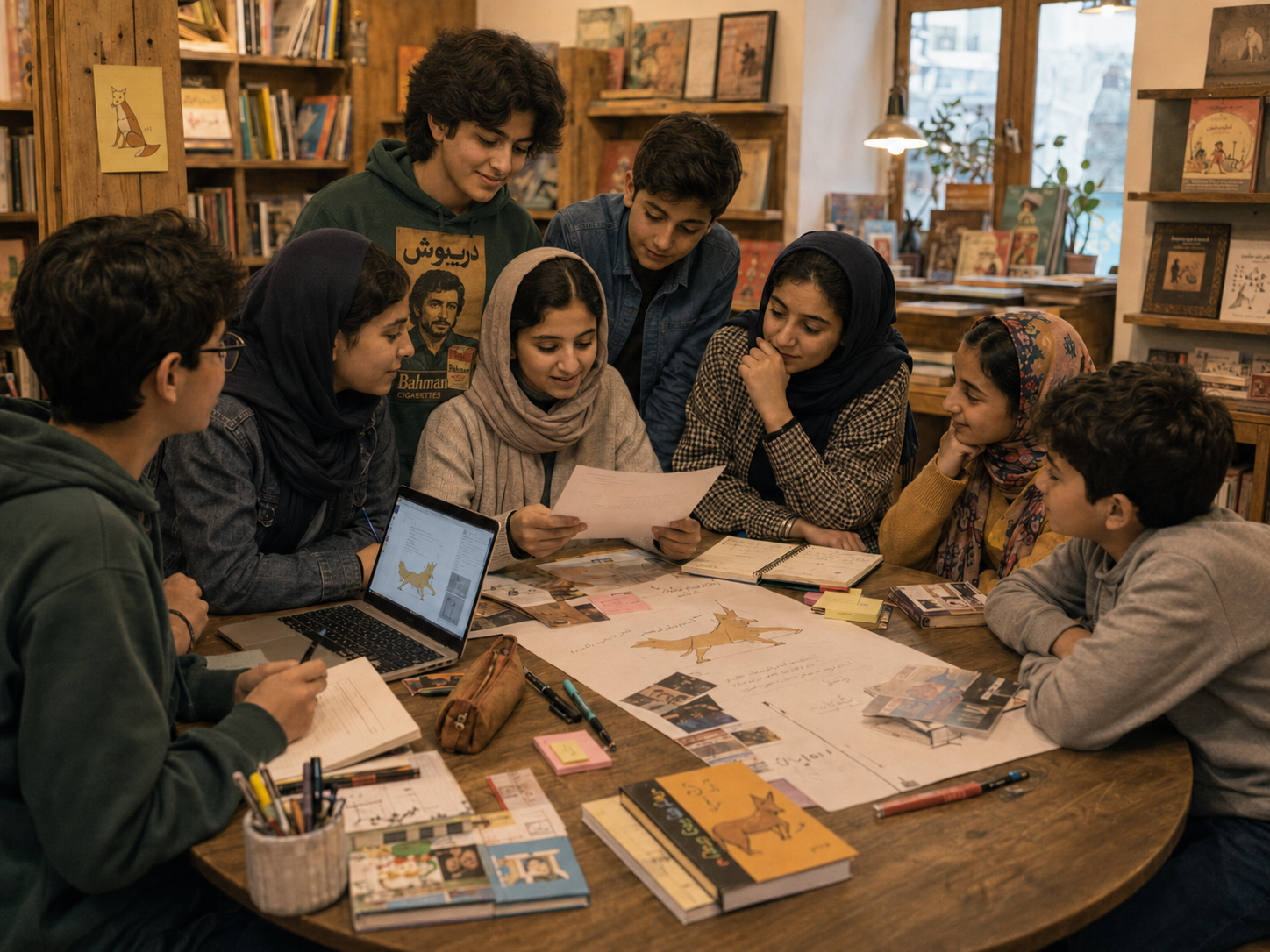
Let us make one foundational principle clear from the outset: nobody in the Sand Fox Award has a privileged vote. Neither myself nor any of the young organizers attending our planning sessions hold extra electoral weight. Each of us possesses exactly one vote, identical to every other participating young judge across Iran. Even if I develop an intense personal affinity for a particular title, my vote will never count twice simply because I sit on the organizing committee.
The Sand Fox Award (Roobah-e Sheni)—established under the auspices of BookCity as an independent national literary prize where young readers aged 11 to 18 independently nominate, critique, and elect Iran’s premier books without adult intervention—is built entirely upon authentic youth agency. The difference for those of us on the operational team lies elsewhere. We do not merely cast our ballots and walk away. Behind the scenes, we sift through hundreds of incoming reader reviews and reading logs submitted through the online platform (sandfox.ir), carefully categorizing diverse perspectives across fiction and translation.
Sometimes we spend ten minutes debating whether a promotional poster headline should sit higher or lower on the page. On other days, entire discussions revolve around selecting the precise visual cue to open an introductory reel. This collaborative process is rarely straightforward or friction-free. I might propose an idea with utmost confidence, only to have three fellow team members candidly disagree. Conversely, an initial draft that nobody initially favors can, after collective revisions, evolve into the exact shared vision everyone endorses. Frequently, planning sessions conclude with debates still underway and answers yet to emerge.
When preparing promotional posters to distribute among traditional bookstores along Tehran’s storied Enghelab Street, one quickly realizes that design on a digital screen behaves very differently from reality. On a laptop, elements can be repositioned endlessly; inside a bustling brick-and-mortar bookstore, you must stand before a living human being and explain within two minutes what Sand Fox represents and why young voices matter.
Ultimately, votes in the Sand Fox Award are never mere statistics. Alongside every single numeric ballot sits an authentic young reader who discovered a story, formed an opinion, and articulated their judgment. Reading their reflections reveals that literary choices are seldom as tidy or linear as spreadsheets suggest. We remain dedicated to a central inquiry: how can we invite even more adolescents into this collective conversation—especially those who read quietly yet doubt that their voice carries weight? Opening that welcoming threshold is our true collective responsibility. Each of us holds only one vote, but when that single vote is accompanied by reflection, dialogue, and communal stewardship, it ceases to be just a number.<