

When American and Israeli bombs shattered our windows, hurled our shelves to the floor, and cracked our walls, something in this city refused to break: our need to read, to remember, and to honor life.
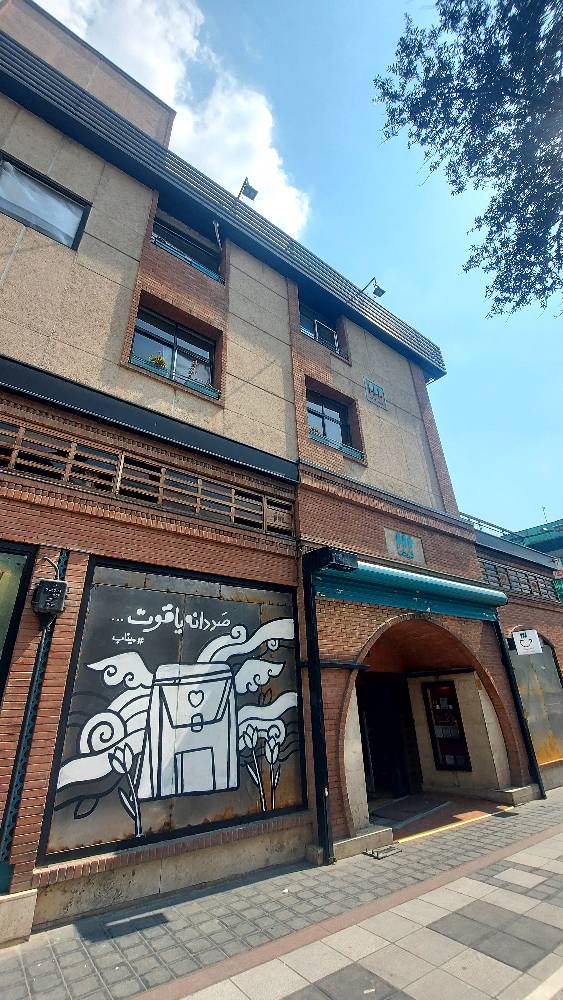
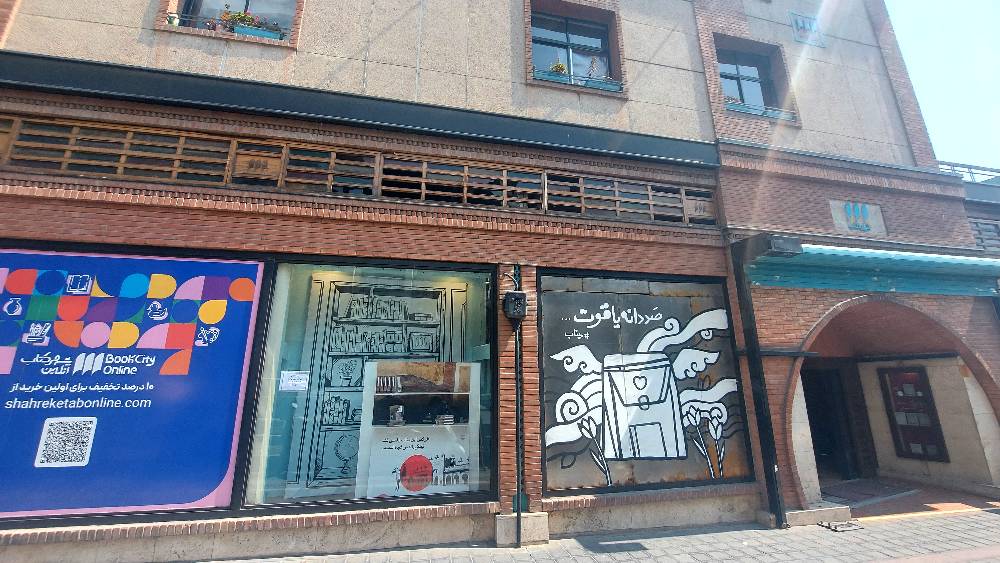
BookCity, whose glass front gave way under the shockwaves of bombardment, began to breathe again on 22 March / 2 Farvardin. The way back to the books reopened, not through a bright window you could look into from the street, but behind cold, uneasy sheets of metal that had been fixed in its place. It did not take long for the creative lovers of people BookCity to do what such places do when the world turns hard: they took what was only a shield and turned it into a sign. The rough metal skin became a surface for hope and a wall where pain and endurance could be seen.
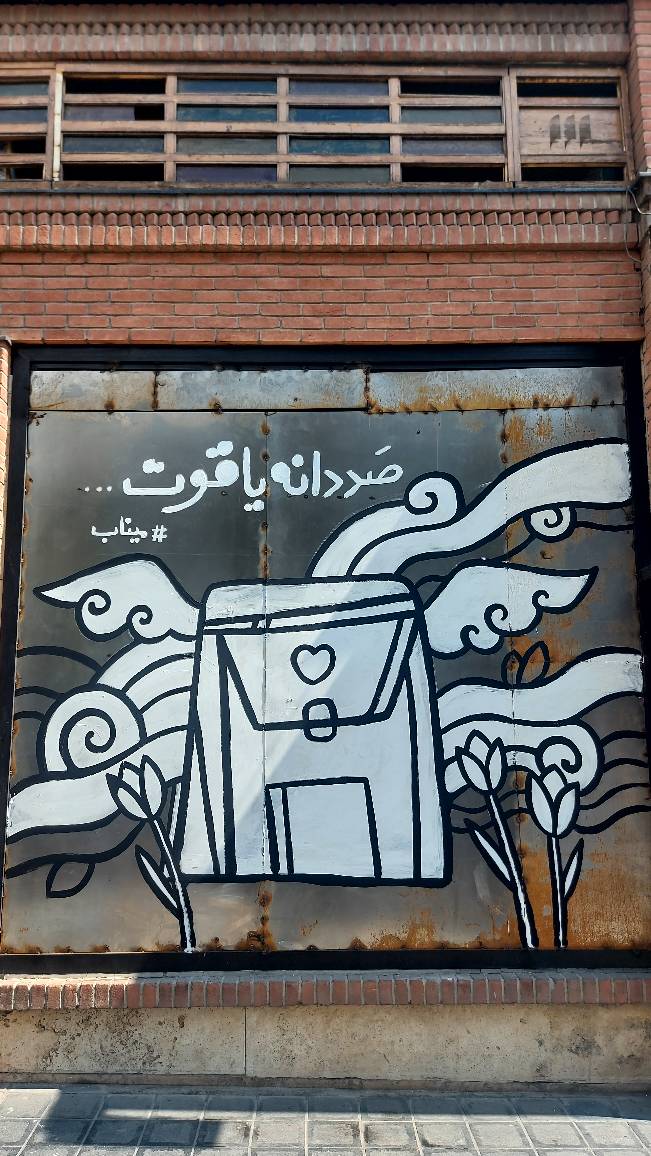
The new work painted there is more than a mural. It stands as a plain, steady mark of human resolve.
Across the steel, the line from a Persian school text, “Sad Dāneh Yāghūt”—literally, “One Hundred Ruby Seeds”—is written beside the hashtag #Minab, the outline of a schoolbag, red tulips, a pair of wings, and a sense of movement, as if the bag itself is held inside the hint of flight. It calls to mind names that are now, as we say in Persian, “written in the sky’s attendance book”: the children and teachers of a school in Minab who were killed in a missile strike—168 students and teachers, each one a life that might have lit tomorrow in this land.
For an English reader, “One Hundred Ruby Seeds” needs to be opened. In Iran, “Sad Dāneh Yāghūt” is the first line of a well-known children’s poem, learned and recited in schools and homes for generations. It speaks of the pomegranate, a round, modest fruit held in the hand, and of the many, close-packed, dark red seeds inside it, likened to rubies set side by side. The poem belongs to the sound of childhood: classrooms, first readers, evenings at home; a world of simple wonder and quiet order; a sense of peace, and of a guiding hand in nature. The image of pomegranate seeds—many, near, held together—carries with it a sense of belonging, shared life, and a tightly gathered future folded into something small.
On this wall, the phrase is no longer only a lesson or a nursery rhyme. It becomes a sign of a childhood that should have known play, study, and the slow, certain growing of days—but met, instead, the blunt force of missiles and fire. These words were meant for school notebooks, not for lists of the dead. That schoolbag was meant to hold pencils and pages, not to stand as a mark of the last morning it was carried.
BookCity, itself wounded, speaks through this image:
Culture is not glass (shisheh) that shatters at the first blow.
Culture is a root system (risheh), running through books, language, poetry, and shared memory.
When walls crack, we paint along the cracks.
When storefronts break, stories push their way out through the fractures.
This artwork honors the children of Minab, but it does more than mourn. It invites us to read in their memory, to tell stories in their names, to love schools with a fiercer tenderness, and—each time we turn a page—to keep one of those “ruby seeds” alive.
Now the metal sheets on Central BookCity’s façade map a passage from hurt to hope. They stand as a sign that says:
A storefront can be broken, but reading cannot be stopped.
A school can be struck by bombs, but the dream of learning cannot be pulled out of a child’s heart.
BookCity stands with its people and with the memory of Minab, and goes on with its work: with every book placed in a reader’s hands; with every child moving slowly between the shelves, a parent’s hand in theirs; with every passerby who stops before the painting and quietly repeats a line that many generations of children have known:
“One hundred ruby seeds, clustered together…
Now they sit upon the clouds and look down at us—and we promise their story will not be left unfinished.”
This text and this image are BookCity’s small offering to the vast memory of Minab’s children, and an old, stubborn belief spoken once more:
Culture remains.
Books remain.
And a people who can grieve, remember, and rise again will not be brought to their knees.