


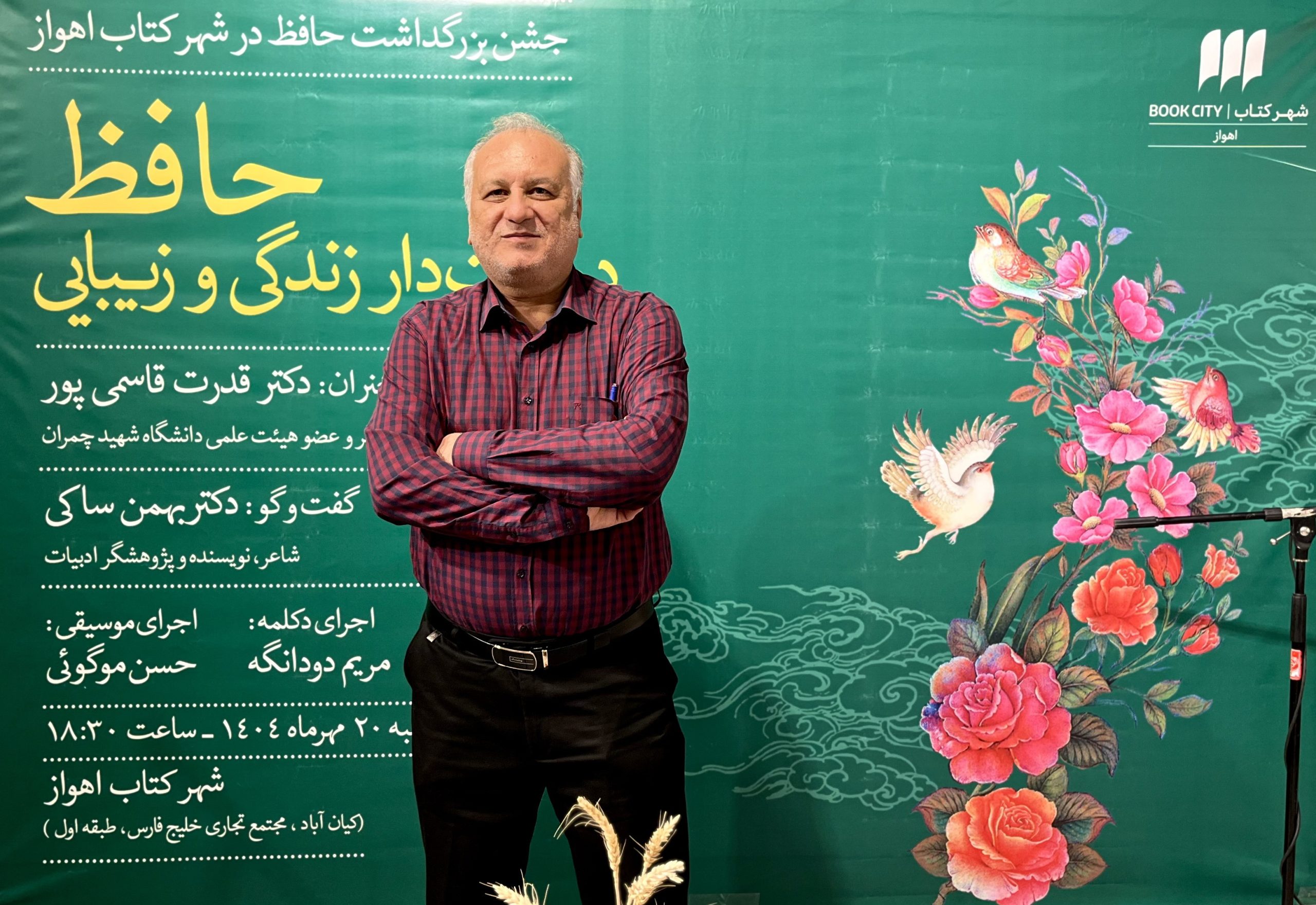
Hafez Day Special Program Held at Ahvaz BookCity
The ceremony titled “Hafez, the Devotee of Life and Beauty” was held on the evening of Sunday, October 12, 2025, at Ahvaz BookCity, featuring a lecture by Dr. Ghodrat Ghasemipour and a dialogue with Dr. Bahman Saki. The speakers emphasized the multi-layered nature of Hafez’s ghazals and the mirror-like quality of his text, viewing the interconnection of life, beauty, and philosophy as key to the enduring appeal of his Divan. The program was hosted by Maryam Doodangeh, with musical accompaniment by Hassan Moguyee.
Dr. Ghasemipour noted that “by Hafez, we also mean the collective memory of Persian culture,” adding that Hafez’s poetry invites the reader to participate; his text is “open,” allowing each audience to see their own reflection within it. According to him, life and beauty in Hafez’s world are two sides of the same coin, and this coexistence elevates his poetry beyond the realm of ordinary ghazal, turning Hafez into a lasting symbol in Persian literature.
Offering a historical overview, he continued: before Hafez, Rumi had brought the mystical ghazal to its peak, but Hafez, with remarkable courage, intertwined themes such as libertinism, the praise of love, and even panegyric within the ghazal form — sparking what he called an “intellectual revolution” in Persian poetry. Referring to the verse *“We wait upon the shore of annihilation, O cupbearer; seize the moment, for between lip and mouth lies no such distance,”* Ghasemipour highlighted the concept of *carpe diem* in Hafez’s Divan — a vision that, unlike Khayyam’s philosophical melancholy, leans toward an “aware joyfulness.”
Explaining the layered symbolism in Hafez’s verses, he referred to the line *“In wine-worship I cast my own image upon the water, to erase the figure of self-adoration”* and described *wine* as bearing three possible readings — mystical, literal, and literary — a signifier that, depending on context, may symbolize the renunciation of self-worship or a means to open new horizons of meaning.
The scholar further emphasized the “refined language” and rhetorical subtlety of Hafez’s Divan, identifying features such as tonal unity, syntactic coherence, and the use of rhetorical devices like *ḥusn-e taʿlil*, pun, and double entendre as the foundations of the poet’s enduring impact. In an analytical comparison, he observed that while some poets, such as Khaqani, display great technical mastery, it is the strong “presence of the human” that distinguishes Hafez’s poetry. Likewise, whereas certain of Saadi’s ghazals show repetition of theme, every “section” of Hafez’s ghazals opens a new horizon, sustaining the reader’s engagement through constant innovation.
In the dialogue segment, Dr. Bahman Saki explained the “cohesive world of Hafez’s thought,” stating that in Hafez’s poetry, sorrow and joy are not opposites but complementary forces that create harmony together. Drawing attention to Hafez’s precision in word choice — including the nuanced distinction between *havādāri* and *havākhāhi* (“affection” and “devotion”) — he attributed the poet’s brilliance to the structural firmness of his form. “Hafez, like all Iranians, is multifaceted,” Saki said. “What makes him shine like a diamond is not his relation to faith or disbelief, but his art — the summit of aesthetic beauty.” He described Hafez’s poetry as an embodiment of “art for art’s sake,” offering “a delight beyond knowing,” and, citing Shafi‘i-Kadkani, added: “Poetry is like a two-way street; to seek omens from Hafez’s Divan is to converse with the poet — a dialogue that still continues.”
This event was part of Ahvaz BookCity’s ongoing literary programs, and similar sessions featuring scholars and researchers will continue in the coming months.
Tags: Ahvaz, Ahvaz BookCity, Hafiz