


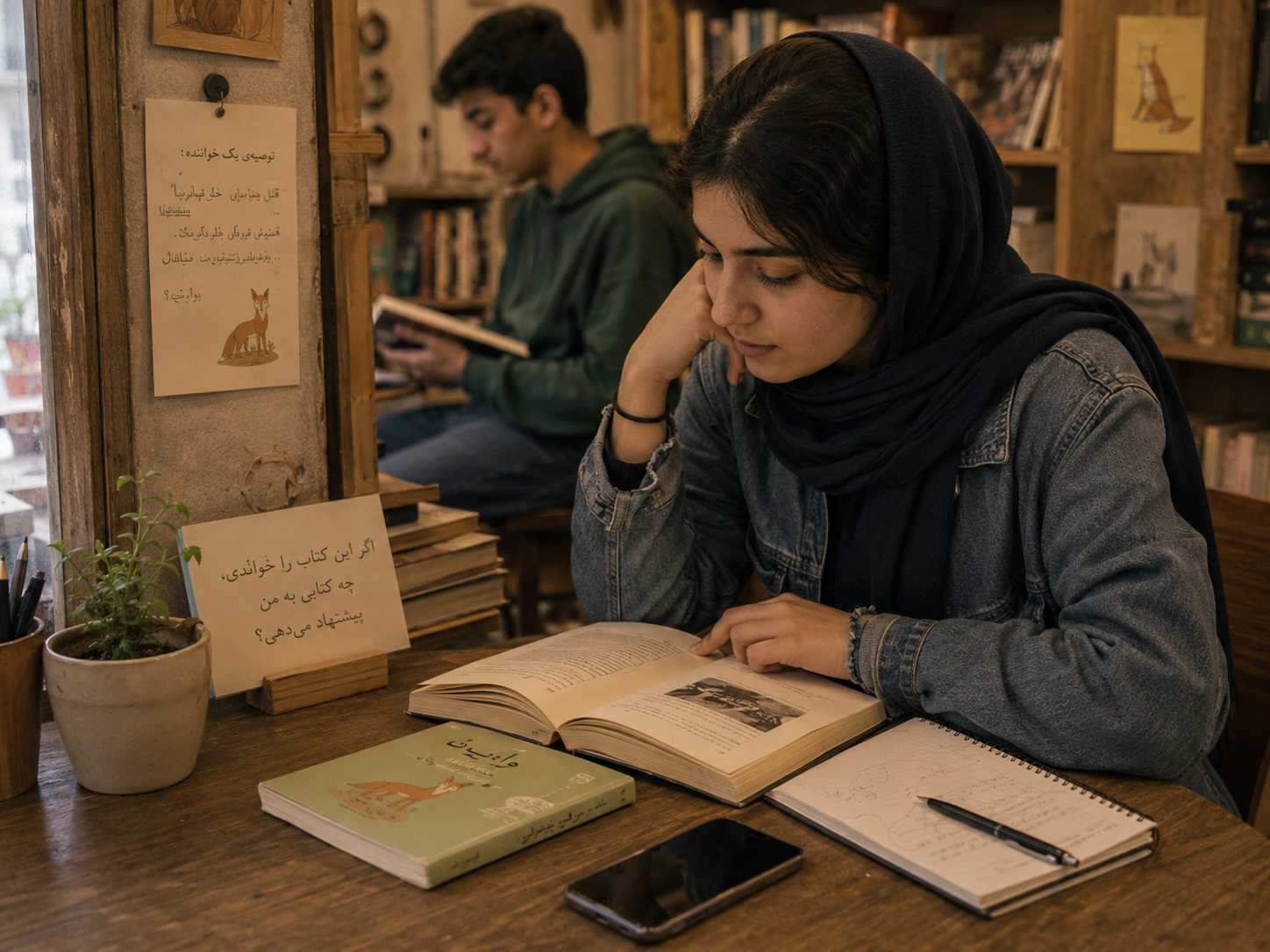
Nobody needs to announce themselves or explicitly define what kind of reader they are. Spend just a few sessions together in the Sand Fox Award reading circles, and a young person’s reading habits disclose themselves naturally: through the book recommendations they offer, the volumes they quietly set aside without finishing, and the precise moments where their eyes light up with enthusiasm.
One person might finish a book every single day, keeping a meticulously detailed reading log on the Sand Fox platform (sandfox.ir). Another might linger over a single narrative for an entire month, living alongside the characters, repeatedly re-reading chosen paragraphs until the paper frays. Yet another reader may have stopped reading conventional adolescent fiction entirely, preferring philosophical essays, world history, or technical treatises. In an ordinary classroom or rigid reading curriculum, these three profiles might be compared or ranked hierarchically. But within the Sand Fox Award—an independent national literary initiative sponsored by BookCity where readers aged 11 to 18 independently evaluate and choose Iran’s premier books without adult tutelage—all three approaches are greeted as valid and essential.
Reading as an identity is rarely about how many books you have conquered. It is far more about what happens to you when you read, and how you articulate your perspective when invited to judge literature. When our young jury members gather, you witness adolescents discovering their authentic critical voice. They realize that disagreeing with an established author or an acclaimed translation is not a transgression, but the very beginning of genuine literary taste.
Adolescence is fundamentally an era of searching for oneself. In our culture, young people frequently encounter identities handed down pre-packaged by schools, social media, or parental expectations. Reading independently offers one of the few unmonitored territories where young people construct who they are from the inside out. When an adolescent votes in Sand Fox, they are not simply choosing an award-winning book; they are asserting: This is how I interpret the world, this is what moves me, and this is where I stand.